
A Brief Intro: Cannabis & Heat
Cannabis, a multifaceted plant renowned for its psychoactive and medicinal attributes, embarks on a captivating transformation when exposed to heat. This intricate process, known as decarboxylation, (that’s dee-car-box-uh-LAY-shun). It serves as the gateway to unleashing the potency and efficacy of cannabinoids within cannabis. In other terms, decarbing is critical to enjoying THC. This article delves into the intricacies of decarboxylation, its impact on THC and other cannabinoids, the significance of THCA, the art of interpreting product labels, and the guidance budtenders require to adeptly navigate customer interactions.
Look, this one may sound complicated, but it’s not, if you’ll read it and focus on it, you already know this information. We are here to help you remember it and then use it. You can’t forget that as a professional Budtender, part of your job is knowing things about cannabis!
The Chemistry of Combustion: Unraveling Cannabis Transformation
When cannabis undergoes combustion or heating (about which we spoke in our last article), a symphony of chemical reactions unfolds, liberating active compounds, including cannabinoids. A central protagonist in this intricate ballet is tetrahydrocannabinolic acid (THCA), a prominent constituent of raw cannabis. In this state, it must be heated in order to turn THCA into THC.
The Metamorphosis from THCA to THC
At the core of cannabis’s psychoactive effects lies THC, the renowned compound responsible for inducing the “high.” Yet, in its natural state, THC predominantly exists as THCA within the cannabis plant. The application of heat initiates decarboxylation, shedding a carboxyl group (COOH). This transformation transmutes THCA into THC, enabling engagement with cannabinoid receptors in the brain. Put another way, the THCA molecule is retooled by proteins to give it a new shape and function, namely, producing psychoactive and medicinal effects in humans.
Here’s what this looks like on paper:
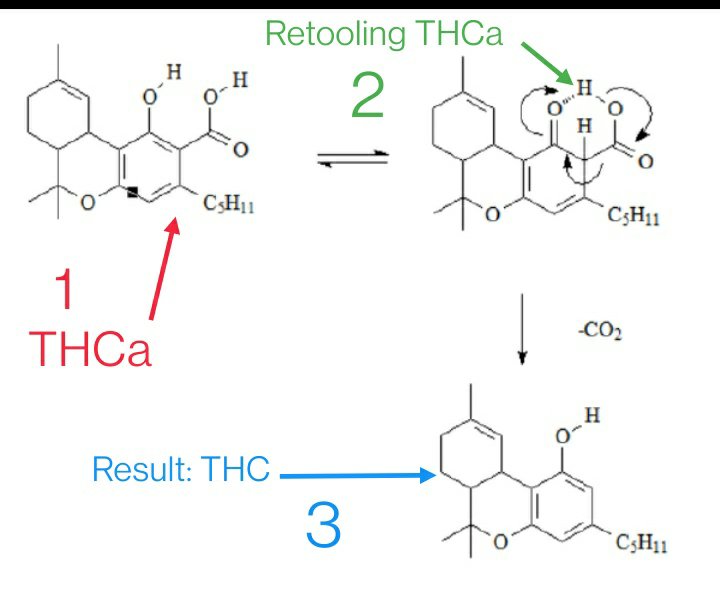
The Dance of Degradation and Transition
Cannabinoid degradation refers to the gradual breakdown of these compounds due to environmental factors such as light, heat, and oxygen. As these influences encroach, cannabinoids may deteriorate, impacting product potency, on top of the issues around bioavailability. The evolution from THCA to THC represents a shift from dormancy to activation, unveiling the plant’s latent potential.
Probing THCA: The Precursor to THC
THCA, or tetrahydrocannabinolic acid, assumes a pivotal role as a foundational cannabinoid within raw cannabis. This compound stands as the precursor to THC, holding influence prior to its transformation through decarboxylation.
THCA’s Journey and Transformation
Elevating cannabis’s mystique, the transition from THCA to THC is illuminated through decarboxylation. With the embrace of heat, this conversion transpires, freeing the psychoactive qualities of THC. However, neglect can induce degradation, guiding THCA’s transformation into cannabinolic acid (CBNA), a subdued counterpart to THC’s potency.
A Quick Note on Edibles & Tinctures
Decarboxylation is one of the most important processes when making edibles, tinctures, and other consumable goods, because there is no heat added during consumption of these products. Decarbing activates the plant’s most essential cannabinoids: tetrahydrocannabinol (THC) and cannabidiol (CBD). For smokeables, decarboxylation prior to consumption is not necessary, as it happens when the flame or electric heating element hits the plant.
Decoding Labels: Unveiling THC Content
Within product labels, a conundrum awaits elucidation: 36% of the THC value resides in THCA. This enigmatic statement denotes a substantial THCA presence yet to be activated. Deciphering this linguistic riddle requires discerning the combined potency of activated THC and latent THCA.
A Lexical Map – Navigating Label Interpretation
Decoding the enigma of labels necessitates comprehending both THC and THCA content. The numerical fusion encapsulates the spectrum of effects awaiting exploration, mirroring the potential of the product’s symphonic interplay.
The Prelude to Psychoactivity – Decarboxylation’s Overture
Within the sanctum of decarboxylation, THC’s metamorphosis bestows upon it the power of psychoactivity, the ultimate goal of all people’s endeavoring. We build entire economies around psychoactivity. W2However, THCA’s presence introduces a subtler prelude until the curtain rises, revealing nuanced intricacies. The crescendo of psychoactive symphony unfurls upon heating, an alchemical testament to decarboxylation’s prowess.
Guiding the Cannabis Custodian: Insights for Budtenders
For budtenders, bearers of cannabis wisdom, mastering the realm of decarboxylation, THCA, degradation, and label subtleties is imperative for fostering enriched customer dialogue.
The Art of Discourse – Nurturing Customer Understanding
Elevating a product boasting 36% THCA necessitates ascending the pinnacle of knowledge. Paint an intricate canvas of information, elucidating the dynamic interplay of THCA and decarboxylation. Steer this discourse with finesse, conducting an ensemble of choice and awareness, thereby enriching the customer’s journey.
Beyond the Transaction – Cultivating Empowerment
Beyond product transactions, budtenders bear the mantle of empowerment. By arming customers with knowledge about decarboxylation’s dance, the role of THCA, and the alchemy of labels, budtenders nurture informed decision-making and elevate the cannabis experience. In this symbiotic dance, budtenders become patrons of knowledge, guiding customers toward an elevated understanding of the plant’s potential.
In summation, decarboxylation stands as the fulcrum upon which cannabis’s potential teeters. The THCA-THC interplay encapsulates an alchemical dance of transformation, yielding the symphony of psychoactivity. Deciphering label cryptograms becomes an art, a skill fortified in the budtender’s repertoire. As they weave a tapestry of understanding, the customer journeys forth, armed with insight, into the realm of elevated experience.
Embrace Enlightenment
Relevant Peer-Reviewed Scientific Research to Begin Understanding
- “Decarboxylation Study of Acidic Cannabinoids: A Novel Approach Using Ultra-High-Performance Supercritical Fluid Chromatography/Photodiode Array-Mass Spectrometry” by Ivan Vuckovic, Reingard Grabnar, Borut Smidovnik. Cannabis and Cannabinoid Research, 2016.
- “Cannabis Inflorescence and Leaf Metabolomes: A Comprehensive Exploration of Compounds with Bioactivity” by Julia Mudge et al. Frontiers in Plant Science, 2019.
- “Cannabis and Cannabis Extracts: Greater Than the Sum of Their Parts?” by Ethan B. Russo. Journal of Cannabis Therapeutics, 2004.
- “Cannabis Oil: chemical evaluation of an upcoming cannabis-based medicine” by Paul W.B. van den Dool, Arno Hazekamp. Cannabinoids, 2010.
- “Evaluation of Cannabidiol, Cannabidiolic Acid, and Cannabigerol in Mouse Brain by Using HPLC-ESI-QTOF-MS” by Kinga Gawel et al. Chromatographia, 2018.
- “Decarboxylation of Δ9-Tetrahydrocannabinolic Acid (THCA) to Active THC” by Mahmoud A. ElSohly, Zlatko Mehmedic, et al. Cannabis and Cannabinoid Research, 2016.

 Chronicler Cannabis Historians
Leave a comment