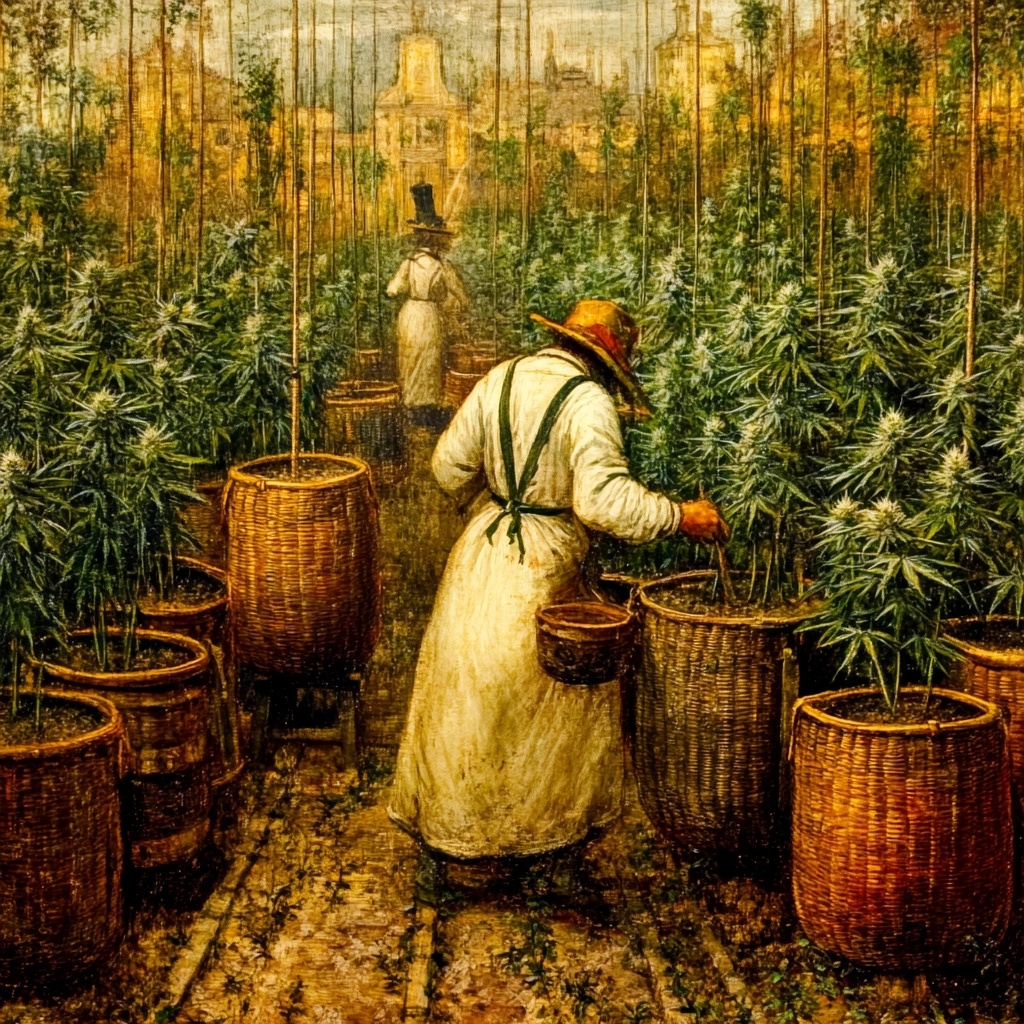
The proceeding is the first installment in what will be a three-part series on the topic of cannahistory. We begin with a brief examination of major eras of human history and their connections with cannabis in all its iterations.
The Discovery of Cannabis Inhalation in the Paleolithic and Neolithic Periods
Human use of cannabis dates back thousands of years, but the discovery of its psychoactive properties, particularly through inhalation, likely occurred by accident. During the Paleolithic (2.5 million to 10,000 BCE) and Neolithic (10,000 to 4,000 BCE) periods, early humans were making significant advances in agriculture, fire use, and plant experimentation, which likely played a role in uncovering the effects of cannabis smoke.
Accidental Exposure to Burning Cannabis
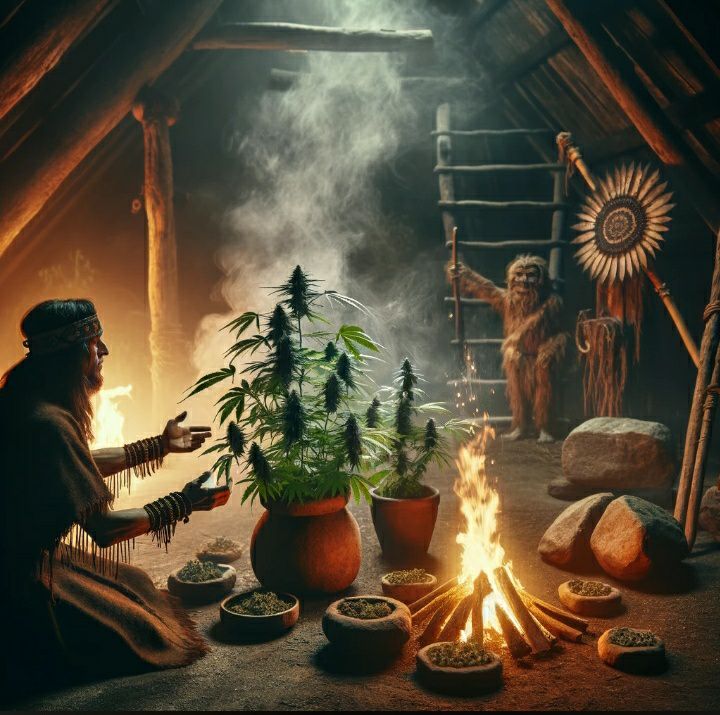
The most plausible hypothesis is that early humans accidentally discovered cannabis’ psychoactive effects when wild plants were burned in fires used for warmth or cooking. Cannabis, native to Central Asia, could have been thrown into fires or inadvertently burned alongside other materials. As a result, people near these fires would have inhaled the smoke and experienced its psychoactive effects.
“The discovery of psychoactive plants by early humans was often the result of accidental exposure to their fumes or consumption.” — Dr. Richard Evans Schultes, ethnobotanist
Ritual and Medicinal Use of Cannabis
As humans transitioned to agriculture in the Neolithic period, they began using plants for medicinal and spiritual purposes. Evidence from burial sites, such as the Yanghai Tombs in China (2,500 BCE), suggests that cannabis was intentionally burned in ceremonial contexts, possibly to alter consciousness during rituals. Additionally, it’s plausible that medicinal use of cannabis led to the discovery of its psychoactive effects through inhalation when plant material was heated.
Use of Cannabis in Early Smoking Tools
Though direct evidence of inhalation from the Paleolithic period is scarce, some researchers argue that early humans may have developed rudimentary smoking tools as part of their interaction with fire. The Scythians (around the 5th century BCE) are known to have used pipes for inhaling cannabis smoke, and it’s possible similar techniques existed in simpler forms during earlier periods.
Its important to be reminded that these changes took place over potentially millions of years, if you accept the current archaeological record. Humans wouldnt have just had an epiphany that caused them to craft a smoking device like a pipe; rather there would’ve been rudimentary–extremely simple devices that came about as the result of realizations by humans.
Archaeological Evidence and Historical Context
Archaeological discoveries, such as burned cannabis seeds found in ancient graves, provide indirect evidence of inhalation. While most of the evidence points to Neolithic use, it is plausible that earlier Paleolithic humans, particularly those who regularly used fire, could have encountered similar effects from accidental exposure.
Because our ancestors were well versed in capturing and controlling fire, the historical record is full of instances where major human advancements occurred alongside the use of fire by humans.
Refer to:
Herodotus. The Histories, 440 BCE, Book 4. Translated by Aubrey de Sélincourt. Harmondsworth: Penguin Classics, 1972.
For more detailed studies on the ancient use of cannabis, see “Archaeobotanical Evidence of Ancient Cannabis Consumption” in the Journal of Archaeological Science, vol. 67, 2016.
What Were They Smoking?
Throughout time, the precise nature of what kind of cannabis early humans were consuming changed fairly drastically. It seems that the different eras in time can be accompanied by a specific iteration of cannabis, from seeds in the Paleolithic to Concentrates in the Modern day.
Just like the decades of the 20th century were characterized and partially identified by trends like clothing, architecture, and hairdos, (think 1920s zoot suits or the “glamour rock” hairdos of the 1980’s), we can view the chronology of human history via the iteration and utility of cannabis. Read on for more!
What’s in this Article?
- The Ancient Beginnings: Pre-500 BCE
- Cannabis in Classical Antiquity: 500 BCE – 500 CE
- The Middle Ages: 500 CE – 1500 CE
- The Age of Exploration: 1500 CE – 1700 CE
- The Industrial Revolution: 1700 CE – 1900 CE
- Modern Criminalization as an Anomaly
- Legal Perception of Religious Cannabis Use
- So What Can We Say?
Human History is Cannabis History
Cannabis has journeyed alongside humanity from ancient civilizations to the modern day, influencing and adapting to our cultures. We humans have organized whole civilizations around this plant, coming to rely upon it as a cyclically generous product crucial to human advancement.
Initially revered for its mystical and medicinal properties, cannabis later evolved into a global commodity. In the 20th century, it became unwisely vilified, only for its therapeutic potential to be rediscovered in the present day.
The Ancient Beginnings: Pre-500 BCE
In one of the most fascinating epochs of cannahuman history, we observe the end of the Neolithic Period, going back thousands of years, leading up to 500 years before Jesus Christ.
In the earliest times, cannabis was primarily utilized for its psychoactive properties during rituals and as a medicinal herb. Cannabis seeds were found in a Siberian shaman’s burial site dating back to 500 BCE, indicating its spiritual significance. This period saw the emergence of cannabis strains closely related to modern Indicas, often used in rituals for relaxation and introspection.
Cannabis in Classical Antiquity: 500 BCE – 500 CE
During the Greek and Roman eras, cannabis was recognized for its medicinal uses. Greek physicians like Dioscorides (dye-uh-SCORE-ides) noted its efficacy in treating ailments, including earaches and inflammation. Meanwhile, Roman society relied heavily on hemp for textiles, ropes, and sails. The cannabis strains in this period were likely early versions of sativa, used primarily for its stimulating and practical properties. Interestingly, cannabis strains today harken back to this era with strains like Romulan, named after a fictional race in Star Trek, which got its inspiration from the mythical founders of Rome, one of whose name is called Romulus. If we look closely and enlighten our perspectives a bit we will observe these types of connections across the cannabis industry.

Cannabis Strains of the Era: Early Sativas, used for both medicinal purposes and as a source of fiber for making textiles and sails.
Source: Riddle, J. M. (1985). Dioscorides on Pharmacy and Medicine. University of Texas Press.
The Middle Ages: 500 CE – 1500 CE
The Middle Ages saw cannabis used for medicinal purposes in the Arab world, as documented by renowned scholars such as Al-Razi and Ibn Sina (Avicenna in the West). Additionally, Europe saw widespread cultivation of hemp, which became central to economies reliant on textiles and ropes.
Strains used were typically hemp or ruderalis, low in psychoactive compounds but highly valued for their fibers.

Cannabis Strains of the Era: Hemp and ruderalis, low in THC, were primarily grown for their fiber.
Source: Lozano, I. (2001). The Therapeutic Use of Cannabis in Arabic Medicine. Journal of Cannabis Therapeutics, 1(1), 63-70.
The Age of Exploration: 1500 CE – 1700 CE
With the onset of exploration, cannabis spread globally as European sailors relied on hemp for ship sails and ropes. Spanish explorers introduced cannabis to the Americas for industrial use. Cannabis in this era was cultivated for both industrial hemp and psychoactive properties, with strains tailored to the needs of different regions.
Cannabis Strains of the Era: Strains similar to hemp for fiber production, alongside early psychoactive strains such as hashish, brought to new lands by explorers.
Source: Deitch, R. (2003). Hemp: American History Revisited. Algora Publishing.
The Industrial Revolution: 1700 CE – 1900 CE
The Industrial Revolution further solidified hemp as a key crop, particularly for its utility in producing textiles and ropes. However, cannabis extracts began to enter Western medicine during this period, as new methods of oil extraction were developed. Medicinal strains became popular, with Indica strains often preferred for their therapeutic effects.
Modern Criminalization as an Anomaly
In the 20th century, cannabis faced unprecedented criminalization, primarily in the United States. Previously celebrated for its industrial and medicinal benefits, cannabis became synonymous with social deviance. The passage of the 1937 Marijuana Tax Act marked a drastic shift in public perception. Despite this, cannabis never truly disappeared from popular culture or alternative medicine, with countercultures in the 1960s reviving its psychoactive use.
Humanity survived for millennia thanks in part to the utility of cannabis. From the start of the human record, cannabis has been there someway, somehow. It is in 20th America alone where we witness history’s turn against cannabis at the hands of cronyism and corporatism.
Jack Kilgore, Historian of Polemology, SNHU
Legal Perception of Religious Cannabis Use
In many religions, cannabis has been historically considered a spiritual aid. Yet, modern laws often clash with these ancient traditions. Rastafarianism is one of the few recognized religions where cannabis use is integral, although legal protections vary. Other spiritual uses, such as in Sufism and various indigenous practices, still face legal hurdles, reflecting a disconnect between contemporary legal frameworks and ancient religious traditions.
America was founded for two primary purposes: freedom from tyrannical taxation, and freedom to believe and worship. It’s astounding that Americans, of all people, don’t have the inherent right to use cannabis for ritualistic purposes. It’s blatantly anti American considering hemp’s history.
Al Smith, Ph.D, Professor of African-American Studies, Cal State University Stanislaus


 Chronicler Cannabis Historians
Leave a comment