
The Cannabis War: A Historian’s Analysis (2014–2025)
Phenomenology of War: Conventional vs. the War on Cannabis
Conventional warfare, as per Clausewitz, revolves around armed confrontations, territorial conquests, and clear military objectives. Its signs are material—casualties, destruction, treaties. The War on Cannabis, however, is an asymmetric ideological conflict, orchestrated through legislation, propaganda, arrests, and regulatory manipulation. It’s a war without bombs, yet one with devastating social and economic consequences—disproportionately afflicting communities of color.
This war is total and regionalized, conducted through legal-economic suppression and bureaucratic control. The state, like a counterinsurgent force, launched raids, criminalized operations, and monopolized legal access. Yet cannabis activists countered with strategic lobbying, media engagement, and market adaptation. Over time, the state’s supremacy began to erode under the weight of changing public sentiment and the cannabis sector’s resilience.
- Conflict Overview
- Strategies & Tactics
- Command Structures
- Unseen Machinations
- Key Performance Indicators
- Download Whitepaper
Conflict Overview
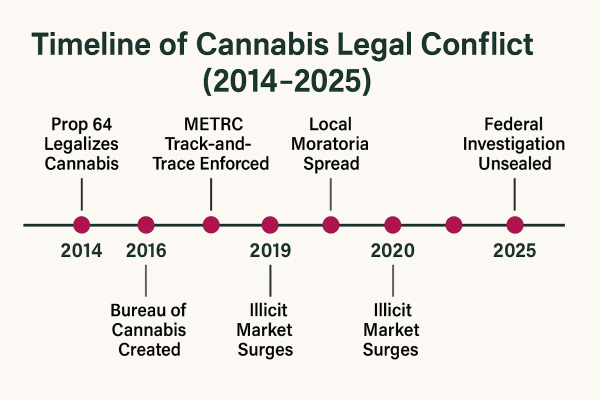
The modern cannabis war ignited with California’s Prop 64 in 2016, unleashing a complex clash between grassroots operators and an emergent bureaucratic state-corporate complex. The battlefield extends far beyond farms and dispensaries—into courtrooms, regulatory bodies, and public opinion. Key turning points include regulatory sweeps, DEA surveillance, and widespread local moratoria. This conflict is as much cultural and economic as it is political, amounting to a generational struggle over dominion of the plant.
It is not merely a policy struggle — it is a generational reckoning over sovereignty (our ability to choose our own destiny for our own reasons), heritage (that which produced us), and the future of a plant once stupidly deemed illicit & without medicinal benefit.
Strategies & Tactics
Statist Forces
The state employed METRC to establish real-time inventory surveillance, zoning laws to restrict dispensary density, and nonrefundable fees that acted as economic barriers. These tactics were dressed in the language of compliance, equity, and public health — but their impact was consolidation and
Industry Forces
Legacy growers and disruptors fought back with guerrilla ingenuity: mobile cultivation units, pseudonymous LLCs, decentralized crypto-financing, and education-focused resistance campaigns. This asymmetric warfare frustrated regulators and prolonged cultural autonomy in the face of creeping corporatism.
Command Structures
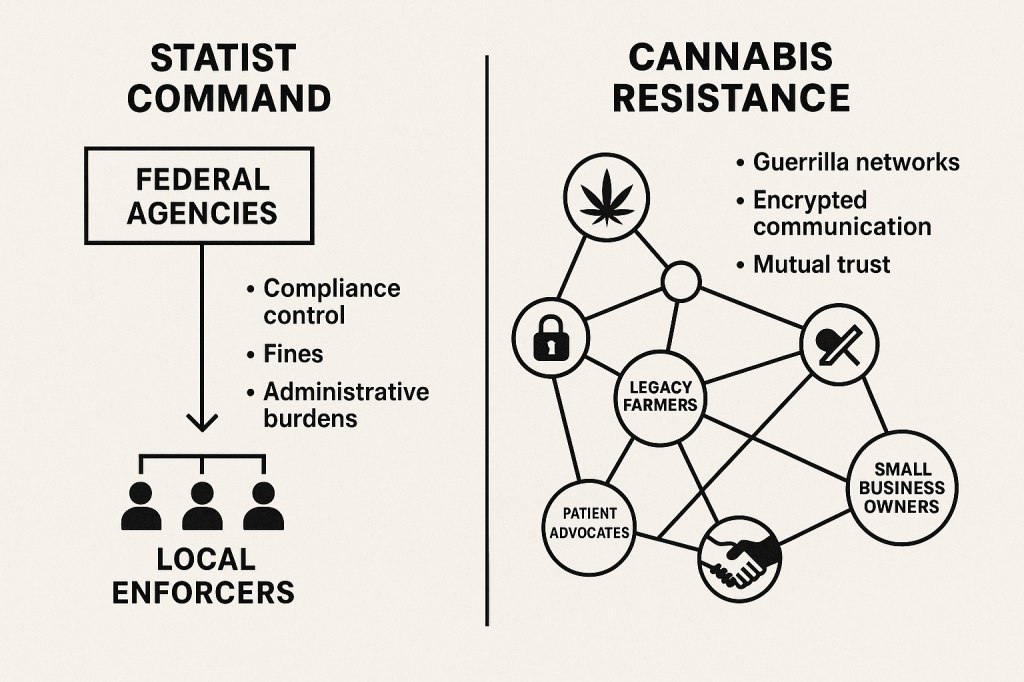
Statist hierarchy flows top-down: from state legislators to agencies, city bureaucrats, then enforcement. The glue is paperwork and penalty. Power accumulates where confusion persists.
Legacy command is lateral. It’s encrypted group chats, oral tradition, and trust-based networks. It mimics insurgency models — decentralized, agile, and invulnerable to single points of failure. Farmers, trimmers, brokers, and advocates operate fluidly, adapting regionally with embedded cultural intelligence.
The Dark Forces in Cannabis
FOIA requests and whistleblower leaks suggest that state-level compliance software like METRC has data-sharing clauses enabling potential handoffs to federal agencies or private security contractors.
Major conglomerates lobbied aggressively to entrench regulations that small operators could not afford to meet, using compliance as a sword, not a shield. The endgame? Market sterilization followed by corporate buyout at pennies on the dollar.
The quiet accumulation of cultivation, sales, and identity data may be laying the groundwork for a cannabis-specific “social credit system,” wherein your compliance profile dictates your access to capital, permits, and freedom of operation.

How Is Victory Achieved?
The following metrics are currently used by historians to measure the effectiveness of the legal system compared with the black market. Refinement and addition is needed, that’s why we need passionate stewards of history.
- Legal vs Illegal Sales Ratio: California (2023): 1:3 — illicit market dominance persists, and will do so unless & until we are granted the same rights and opportunities as the other sectors.
- License Attrition Rate: Over 20% annually among small/independent licensees, primarily pushed out by corporations, stifling climates, or lack of resources.
- Municipal Moratoria: 72% of cities still ban legal cannabis storefronts. When theyre allowed, its usually in light industrial zones. Alcohol & tobacco, to be sure, are available at every corner.
- Average Time to Licensing: 18–24 months for general applicants; longer for equity applicants.
- Retail Price Discrepancy: Legal products still cost 2–4x more than comparable illicit items.
Download the Whitepaper
Access the full research analysis in PDF form for detailed references, charts, and source material.


 Chronicler Cannabis Historians
Leave a comment