Terpenes & Terpenoids: An Introduction
:
Terpenes and terpenoids are captivating compounds found abundantly in nature, with implications that extend far beyond their aromatic allure. In this blog article, we embark on a journey to explore these remarkable substances, their origins, classifications, future prospects, and their relation to the ongoing legalization debate. Join us as we unravel the world of terpenes and shed light on their diverse properties.
What Will I Learn From This? Budtender Learning Outcomes:
Upon completion of this reading material, budtenders will hold to the following learning outcomes:
- Understanding the nature and significance of terpenes and terpenoids as organic compounds found in plants, including cannabis, and their role in providing aroma and flavor.
- Familiarity with the historical context and pioneers in the study of terpenes, such as chemist Sir Robert Robinson, and their contributions to our understanding of these compounds.
- Knowledge of the classifications of terpenes based on the number of isoprene units, with a focus on monoterpenes and an awareness of other classes like sesquiterpenes and diterpenes.
- Insight into the future prospects of terpenes, including the potential for labeling products with terpene profiles and its impact on consumer choices.
- Awareness of the implications of terpenes in relation to the ongoing legalization debate, including contradictions in drug scheduling and the need for evidence-based policies that accurately reflect the potential of these compounds.
- Improved Customer Service Skillsets. Knowledge of terpene profiles provides critical background information on a customers needs, wants, and expectations.
Terpenes and Terpenoids: Nature’s Fragrant Guardians
Terpenes and terpenoids are organic compounds found in various plants, including cannabis; and they can also be found in Essential Oils (EOs) and are related to volatile organic compounds, or VOCs. Terps are responsible for the captivating aromas and flavors that entice our senses. These compounds are synthesized in specialized glandular trichomes, Terpenes play a crucial role in nature, acting as chemical messengers, providing protection against predators, attracting pollinators, and influencing plant growth and development.
Discovery and Pioneers: Tracing the Roots
The discovery of terpenes and terpenoids traces back through the annals of scientific exploration. One significant milestone is the work of chemist Sir Robert Robinson, whose groundbreaking research in the early 20th century shed light on the complex structures and functions of terpenes. His contributions paved the way for further investigations into the diverse world of terpenes.
For an in-depth exploration of the historical context and discovery of terpenes, refer to the research paper “Terpenes: The Fascinating World of Volatile Natural Products” by Witzgall, P. et al. (2018).
Classifications: Monoterpenes, Botanical and Cannabis-Derived Terpenes & Beyond
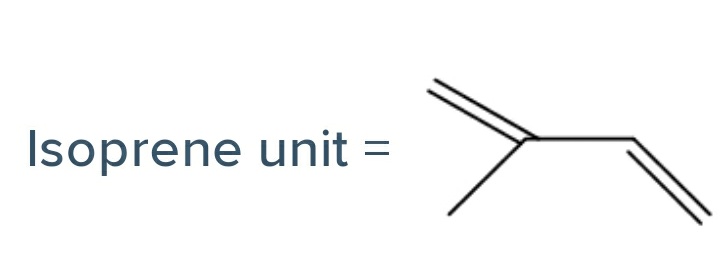
Terpenes are classified based on the number of isoprene units they contain. Monoterpenes, consisting of two isoprene units, are one of the most abundant classes. They contribute to the characteristic scents of fruits, flowers, and herbs. Beyond monoterpenes, there are also sesquiterpenes (three isoprene units), diterpenes (four isoprene units), and other complex terpenes with even larger structures. Each class offers unique properties and potential benefits.
Which Terps Do Budtenders Encounter Most Frequently?
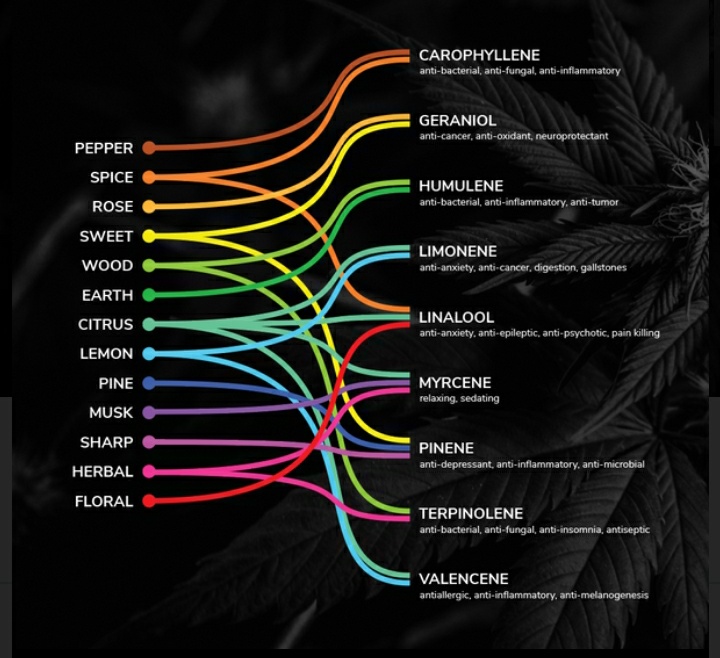
Myrcene: Myrcene is one of the most abundant terpenes in cannabis. It is known for its earthy, herbal, and musky aroma. Myrcene is associated with sedating and relaxing effects and is also found in hops, mangoes, and lemongrass. Studies have shown that strains which hold more than 5% Myrcene are directly responsible for the notorious “couch-lock” effect. What’s more, Myrcene is a powerful analgesic painkiller.
Limonene: Limonene is characterized by its citrusy, lemon-like scent. It is often found in sativa-dominant strains and is believed to have uplifting and mood-enhancing properties. Limonene is also present in citrus fruits like lemons, oranges, and grapefruits.
Caryophyllene: Caryophyllene has a spicy, peppery, and woody aroma. It is the only terpene known to directly interact with the body’s endocannabinoid system, specifically targeting CB2 receptors. Caryophyllene is also found in black pepper, cloves, and cinnamon.
Pinene: Pinene, as the name suggests, has a distinct pine-like aroma. It is commonly associated with strains that exhibit a fresh, forest-like scent. Pinene is known for its potential anti-inflammatory and bronchodilator effects. It is also found in pine trees, rosemary, and basil.
Linalool: Linalool has a floral and slightly spicy aroma. It is often associated with strains known for their calming and relaxing properties. Linalool is found in lavender, chamomile, and coriander and is believed to have potential anti-anxiety and sedative effects
Cannabis-Derived vs. Botanical
The difference between botanical and cannabis-derived terpenes lies in their respective sources and extraction methods:
Botanical Terpenes: Botanical terpenes are derived from various plants other than cannabis. These plants can include fruits, flowers, herbs, and trees. Botanical terpenes are typically extracted through processes like steam distillation or cold pressing, which involve capturing the volatile compounds present in the plant material. As a result, botanical terpenes can offer a wide range of aromatic profiles and flavors.
Cannabis-Derived Terpenes: Cannabis-derived terpenes, as the name suggests, are specifically extracted from cannabis plants. These terpenes are found in various cannabis strains and contribute to the distinctive aromas and flavors associated with different cultivars. Cannabis-derived terpenes can be extracted through methods such as steam distillation, solvent extraction, or advanced techniques like CO2 extraction. These terpenes are often used to enhance the aroma, flavor, and potential effects of cannabis products.
While both botanical and cannabis-derived terpenes share similar chemical structures and contribute to aromatic profiles, their sources differentiate them. Botanical terpenes offer a broader range of aromatic options derived from various plants, whereas cannabis-derived terpenes specifically capture the unique terpene profiles found within cannabis strains. The choice between botanical and cannabis-derived terpenes may depend on the desired aroma, flavor, and specific application or use case.
The Future of Terpenes: Aromatic Labels and Beyond
Labeling with Terpene Profiles:
As our understanding of terpenes grows, there is a burgeoning interest in labeling products with terpene profiles. By providing detailed information about the specific terpenes present in a product, consumers can make more informed choices based on their desired aroma, flavor, and potential effects. When customers can reference and target with specificity the effects they do and don’t prefer, it makes for a smoother purchasing experience, increasing the odds of them returning.
If the industry is going to metamorphose into a terpene-centric one, it will benefit the Budtender immensely because it will give us another vector by which we can identify those properties which customers find the most or the least beneficial. In the future, terpene content could be utilized to create customer preference profiles. As of this writing, some brands, such as Maven, are now incorporating terpene profiles into their package labels, and POS Systems like Meadow are integrating terpene and cannabinoid content information for the ease of the Budtender and customer.
Confirmed Medicinal Properties:
Numerous studies have shed light on the potential medicinal properties of terpenes, with implications for various health conditions. For example, a study by Russo, E.B. et al. (2011) highlighted the therapeutic potential of terpenes, including their anti-inflammatory and analgesic effects. Despite these medical properties, the Federal government still doesn’t see fit to remove Cannabis from it’s Schedule 1 classification.
Challenging the Schedule 1 Classification:
The classification of cannabis as a Schedule 1 drug, while substances like cocaine are classified differently, has rightfully raised questions about the accuracy–and, frankly, the intention–of the current system. The scheduling and controlled substances act employed by the government often fails to align with scientific evidence. For instance, the fact that cannabis, considered Schedule 1, is deemed more dangerous than cocaine, classified as Schedule 2, seems contradictory and warrants further examination. The government’s own policy contradicts its messaging on marijuana being a gateway drug.
Other Important Elements of Terpenes:
Apart from their aroma and potential medicinal properties, terpenes exhibit a range of fascinating characteristics. These include their potential antimicrobial, antioxidant, and insecticidal properties. Additionally, certain terpenes may interact synergistically with cannabinoids, resulting in the entourage effect, where the combined compounds produce enhanced therapeutic effects.:
Terpenes and terpenoids represent a captivating world within the plant kingdom, offering aromatic symphonies and potential therapeutic benefits. As we delve deeper into their properties and classifications, terpenes are poised to revolutionize product labeling and consumer choices. Furthermore, their relation to the ongoing legalization debate highlights the need for evidence-based policies that accurately reflect the potential of these natural compounds. Embrace the fragrant journey of terpenes and unlock the secrets they hold.
• • •

 Chronicler Cannabis Historians
You must be logged in to post a comment.